


Mental Health with Hearing Loss Under the COVID-19
- MENGYAO WANG

- Mar 4, 2022
- 4 min read
Updated: Apr 27, 2022
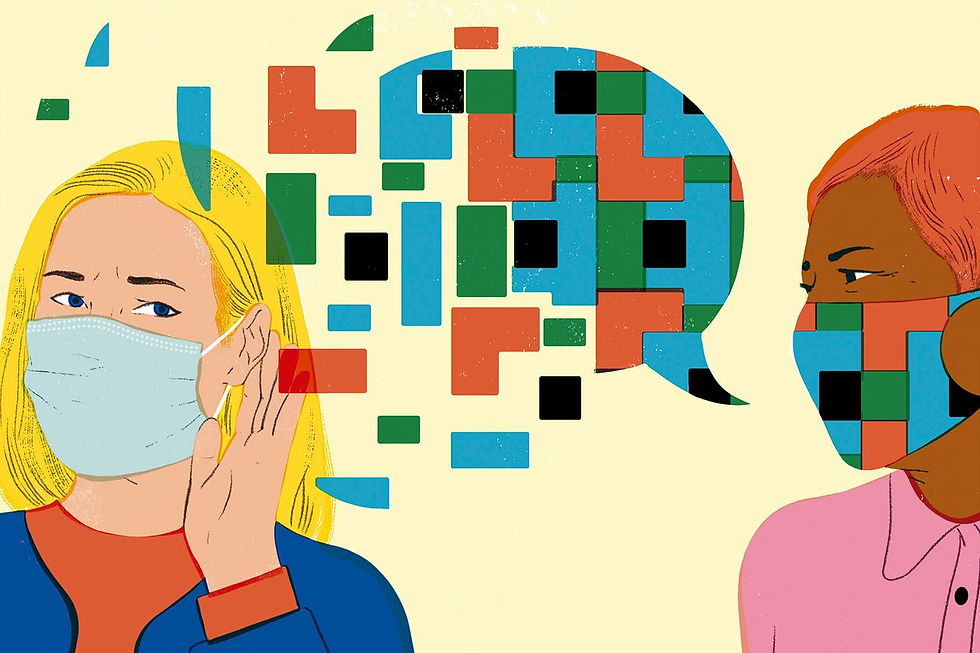
With World Hearing Day taking place yesterday on Thursday (Mar. 3), the theme of the campaign in the World Health Organization, “To hear for life, listen with care”, brings to my attention on mental health issues deaf and hearing-impaired community regarding their communication barriers under the global pandemic. The social ramification of COVID-19 makes this community’s communication process and hearing issues even more difficult because they have a hard time recognizing facial expressions and lip movements to help them understand messages of spoken words. They have to get used to listening to mumbling voices with cover-mouth masks as well as accepting their own slow responses toward information. Consequently, this change may exacerbate the mental health issues they have suffered but online accommodation has gradually equipped to offer people with hearing loss.
Hearing Loss as Disability
Last year in October, I interviewed Paula Possenti-Perez, the director of the Center for Disability Resources at Syracuse University, to conduct a featured coverage about Disability Awareness Month. She mentioned that disability was rooted in perceptions of ableism and “when it was socially constructed, as being medicalized for a deficit model.” Hearing loss is one of the common types of disability and the deaf community sometimes is more likely to struggle with stigma, depression and stress under the communication barriers and adaption of technological accommodation.

People with hearing impairment account for 15% (about 50 million) of the U.S. population in 2021. Before the pandemic, nearly 20% of them have depressive symptoms. The outburst and recurrence of COVID-19 even have made this data rise to 47% and also engendered a myriad of challenges to the existing high rates of mental issues among people with hearing loss. For example, Mary Louise Kelly, an NPR broadcaster who has been having severe hearing loss after 40, narrated misunderstanding and inconvenience happens in her daily life and stated “The Pandemic Has Made My Hearing Problem Even More of a Problem.”
My experiences as a communication major student with hearing loss

As a hearing-impaired media practitioner also, I can not tell how much I relate to Kelly’s story. Communication career fields always entail high efficiency of verbal content-creating in crunch time or in a fast-paced environment. Therefore, giving back instant responses and having good hearing is essential in face-to-face communication to promote work and study effectiveness. Over countless times, I have doubted my capabilities as a good communicator because of my hearing problems. Like what the illustration portrays, some information I got is fragmented and I need to guess and “solve information puzzles” in my brain to process messages through mumbling sounds. Especially during the pandemic, I felt sometimes I was alienated from this masked world. I do not mean to dissent about the universal masking mandate and social distancing protocol because I understand all precautious measures for protecting people’s health safety in this case; however, I have to address the fact that current situations do challenge people who have hearing loss communication problems.
For instance, in an in-person environment, when some of my co-workers or friends repeated their ideas to be more than three times, I still did not get what they meant even if I wore my invisible hearing aids. Sometimes, they were tired of explaining to me over and over again and did not want to waste too much time completing tasks. Once I tried to move closer to the speaker for getting louder and clearer sound, I suddenly realized that I need to keep social distancing. I could not describe how embarrassed, discouraged and sorry I was. Fortunately, I have gradually minimized the negative impacts with behavioral adjustments and sheer determination.
Technological Accommodations and Online communication
Online learning and video platforms facilitate communications for people with hard of hearing in terms of strong visual cues to compensate for the hearing loss. Under the ubiquitous mask-covering protocol, 95% of hearing-impaired people in the U.S. admitted that they experienced communication obstacles while they were wearing masks. Speaking louder sometimes does not help them more clearly hear the voices and understand the messages. But due to the development of remote communication, they increased the use of the Internet online and started to adhere to platforms like zoom, the most common video communication software in the U.S. According to the Association of American Medical Colleges’ research, after advocates such as Shari Eberts and MBA’s requests, the company later ushered in unlimited services to offer captioning or live transcription so that people with hearing loss have access to real-time translation in communication and American Sign Language interpretation via visual.
In summary, raising awareness of understanding the deaf or hard of hearing community’s difficulties under the global pandemic is crucial and beneficial to give them psychological support. 35% of them expressed that they have experienced a lack of empathy from others for their hearing loss because hearing loss is an invisible disability if their hearing aids are worn inside the ear, which people can not easily perceive from the first glance. In my opinion, transparent masks should also be prevalent considering hearing-impaired and deaf communities’ needs. Since mask policies are loosening, it seems a good news for them to come back to involve face-to-face communication. And in the future, the hybrid mode of communication in terms of visual online platforms and in-person conversation under precautionary measures will be a prioritized trend to maintain rehabilitation care toward people with hearing loss.
References:
Burry, M. (2020, September 21). Depression and hearing loss. Healthy Hearing. Retrieved March 4, 2022, from https://www.healthyhearing.com/report/52437-The-complex-link-between-depression-and-hearing-loss
Hearing Loss Association of America. (2021, February 25). HLAA Cochlear pandemic survey. Hearing Loss and the Pandemic. Retrieved March 4, 2022, from https://www.hearingloss.org/hearing-loss-pandemic-survey/
Jawadi, Z. (2022, January 6). I am a medical student with significant hearing loss. here's what the pandemic has been like for me and others with my disability. I am a medical student with significant hearing loss. Here’s what the pandemic has been like for me and others with my disability. Retrieved March 4, 2022, from https://www.aamc.org/news-insights/i-am-medical-student-significant-hearing-loss-here-s-what-pandemic-has-been-me-and-others-my
Kelly, M. L. (2020, July 16). The pandemic has made my hearing problem even more of a problem. The Wall Street Journal. Retrieved March 4, 2022, from https://www.wsj.com/articles/the-pandemic-has-made-my-hearing-problem-even-more-of-a-problem-11594908056
U.S. Department of Health and Human Services. (2021, March 16). Quick statistics about hearing. National Institute of Deafness and Other Communication Disorders. Retrieved March 4, 2022, from https://www.nidcd.nih.gov/health/statistics/quick-statistics-hearing
Wang, M. (2021, October 29). SU celebrates National Disability Employment Awareness Month. The Daily Orange. Retrieved March 4, 2022, from https://dailyorange.com/2021/10/syracuse-university-national-disability-month-disabled-students/


Comments